


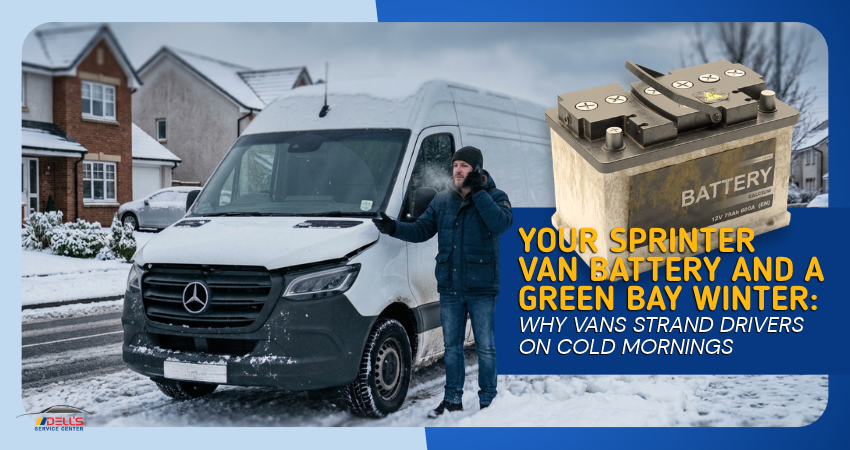
A Sprinter van battery rarely fails on a mild day. It fails on the first bitter morning, when cold has cut its cranking power and a diesel engine needs more of it than at any other time of year. Green Bay delivers that morning every winter. For a plumber or a camper-van owner it costs a day of routes, so the weeks before then are when a weak battery should be caught on a tester instead of in the driveway.
Quick Summary: Key Takeaways
- Cold cuts both ways: the battery delivers less while the engine asks for more.
- The van watches its own battery: Mercedes’ fuse list for 2024–2025 vans puts a battery sensor on the first fuse in the battery box.
- Two batteries, two tests: vans with an auxiliary battery run it through its own cutoff relay.
- Short routes drain it: five-minute hops rarely refill what the starter used.
Cold Mornings Expose a Weak Sprinter Van Battery
Cold rarely kills a healthy battery. It exposes one that was already fading, because battery chemistry slows as the temperature drops just as thick oil makes the engine harder to turn. A diesel Sprinter also powers its glow plugs before the starter turns.
Green Bay gets that cold. National Weather Service records put Green Bay’s normal low in late January at 10°F, and the record low for January 31 is −26°F, set in 1899 and matched in 2019. A van that cranks slowly in November is previewing January. A block heater, if the van has one, eases the cold start but can’t rescue a tired battery. Test it in the fall and you decide when the van is off the road.
Mercedes Wires the Current Sprinter to Monitor Its Battery
Newer Sprinters monitor the battery. Mercedes-Benz’s fuse assignment supplement for the 2024–2025 Sprinter lists a fuse block inside the battery box, and the first fuse in it feeds a battery sensor.
A sensor can report a weak battery, but it can’t clean a terminal. Corrosion at the terminals, or a ground strap that has worked loose, shows up as a slow crank long before it becomes a no-start. A loose ground can mimic a dying battery perfectly. Check connections first.
The Auxiliary Battery Has a Different Job
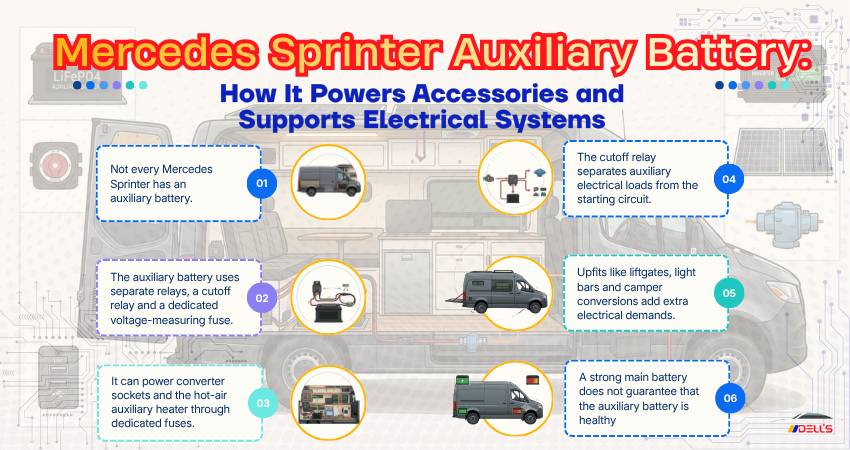
Not every Sprinter has one. Mercedes wires vans with an auxiliary battery differently, with their own relays, a battery cutoff relay and a dedicated fuse for measuring the auxiliary battery’s voltage.
The same supplement shows what can hang off it: converter sockets and the hot-air auxiliary heater, both fused “with auxiliary battery.” So a van that runs a heater or an inverter overnight leans on that second battery, while the cutoff relay keeps those loads apart from the starting circuit. Upfits add more. A liftgate, a light bar or a camper conversion’s house loads all change the picture, and a strong main battery tells you nothing about the auxiliary one.
Short Routes and Parked Weekends Drain Work Vans
Short trips do the most damage. A delivery van that starts eight or ten times a day with the heater and lights on, never going more than a few miles, can end the day with less charge than it started with. Dell’s own guidance puts typical battery life at three to five years, shorter with hard cold and frequent short trips.
Then the van sits all weekend. If something stays awake when it shouldn’t, such as an aftermarket remote starter, a dash camera or an upfit module, the battery drains a little every hour. That’s a parasitic draw. Find the circuit rather than buying a second battery in one winter.
What a Winter Battery Check Should Cover
A proper check covers the whole charging system. It starts with a load test of the main battery and, if fitted, the auxiliary one. Then come the terminals, the fuses in the battery box, the alternator’s output with the van running and any stored fault codes.
Most basic diagnostics take under an hour. Slow cranking, lights that dim when the blower comes on and a van that needs a jump after every long weekend each point somewhere different. Ask for the readings. Next fall’s numbers will show how fast the battery is fading.
Why Green Bay Van Owners Bring Battery Faults Here
Dell’s Service Center has been in business in Green Bay since 1969 and at its Van Der Perren Way building since 1998. Its Sprinter page describes advanced diagnostic scanners and manufacturer-licensed software, which matters on a van that monitors its own battery through a dedicated sensor.
Due for winter fluids too? Test the battery at the same visit. The van loses one morning instead of two, and both the fluids and the battery head into the January cold snaps in a condition you have actually measured.
Frequently Asked Questions
Q: How long does a Sprinter van battery last?
A: Plan on roughly three to five years, and less for a van that makes many short stops or sits outside through a Wisconsin winter. Dell’s own advice is to have a battery inspected at least once a year after its third year, and fall is the time to do it.
Q: Why does my Sprinter crank slowly when it’s cold?
A: Cold cuts the current a battery can deliver while thick oil makes the engine harder to turn. A weak battery shows it first on a cold morning, although corroded terminals or a tired alternator can cause exactly the same slow crank, so a test sorts out which one you have.
Q: Does a Sprinter have two batteries?
A: Some do. Mercedes wires vans with an auxiliary battery through a separate cutoff relay and fuses, and that battery can feed loads like converter sockets and an auxiliary heater. Test it separately.
Sprinter Battery Testing in Green Bay
Drive the van to 840 Van Der Perren Way, Green Bay, WI 54304, and both batteries, the battery box and the charging output can be checked in one visit. Mention the auxiliary battery. When you get in touch through dellsservicecenter.com, include the model year and any upfit equipment, since a liftgate or a camper’s house system changes what gets tested.