


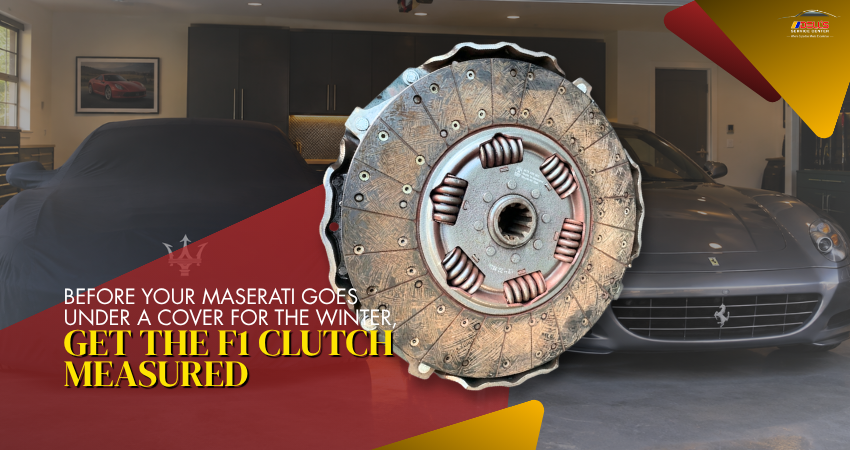
The last warm weekend in Wisconsin usually lands in October. You take the car out. It takes a fraction longer to pull away than it did in June, and you put it away anyway. That hesitation is a number — an F1 clutch wear reading — and any shop with the right factory-level equipment can read it in minutes.
This matters more here than in Florida. Exotic parts do not sit on a shelf in Green Bay. A clutch discovered in April is a car you do not drive in May. Discovered in October, it is a job done quietly over the winter while the car is off the road anyway.
Quick Summary: Key Takeaways
- It is a real clutch: An F1 automated manual uses one dry clutch, operated by a hydraulic actuator instead of your left foot. It wears exactly like a manual clutch does.
- Wear is a measurement: The transmission control unit reports clutch position and wear, so the answer is a figure rather than an opinion.
- Autumn beats spring: Order parts while the car is stored and you lose no driving weeks. Wait until April and you lose the start of the season.
- Slow engagement is the tell: A longer delay pulling away, a judder from a standstill, or a creep in first gear all point one way: a clutch near the end of its travel.
- Since 1969: Ferrari and Maserati work in Green Bay, done by an ASE Master Technician-owned shop that also runs factory software updates.
The F1 gearbox is a manual with a robot working the pedals
Strip the marketing away. A Maserati Duoselect or a Ferrari F1 transmission is a conventional manual gearbox underneath. One dry clutch, one clutch disc, a normal set of gears. What changes is the operator: instead of a pedal and a lever there is a hydraulic pump, an accumulator and an actuator taking orders from a control unit that has no feel and no sympathy, only a map. Every launch is a real clutch engagement, and the computer is not gentler with it than you would be — it is simply more consistent.
So the clutch wears, and it wears fastest in traffic, at low speed, on hills — exactly where it would in a manual car with a nervous driver working the pedal. No computer changes that.
Symptoms that say the clutch is near the end of its range
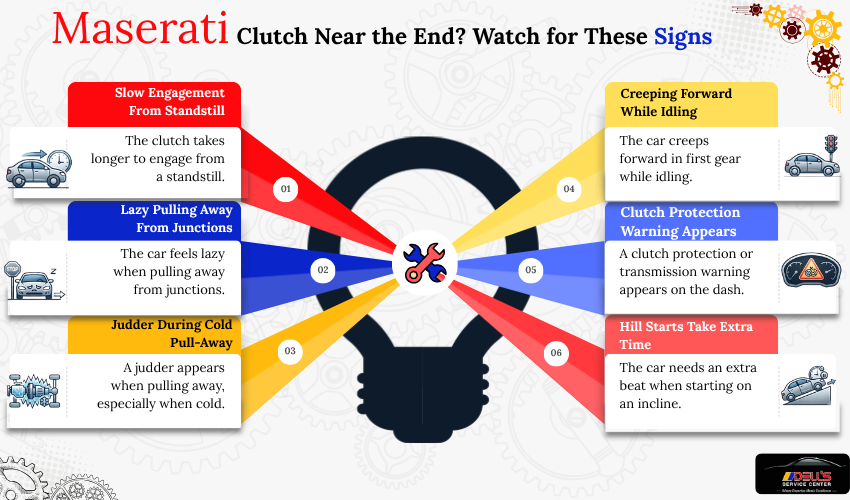
Four signs. All of them creep up slowly enough to be missed. Engagement takes longer from a standstill. The car feels lazy leaving a junction. A judder appears pulling away. Worst when cold. The car creeps forward in first at idle, which means the actuator can no longer fully release. And eventually a clutch protection or transmission warning appears on the dash, often after a few slow-speed manoeuvres in a row.
Hill starts expose it first. If the car needs an extra beat on the incline out of a parking structure, stop guessing and take the reading.
Cold starts and short trips are the hardest miles a stored car does
An exotic that lives in a heated garage and gets driven twelve miles on a Saturday is doing the worst kind of mileage there is. Everything is cold, engagement is at its clumsiest, and the whole drive is over before the gearbox oil has reached a temperature where it can protect anything. The Department of Energy’s own cold-weather guidance says most manufacturers recommend driving off gently after about 30 seconds rather than idling to warm up, and that advice is even more valuable when a computer is slipping a dry clutch for you.
Give it a mile before you ask for anything. Years of clutch life ride on that mile.
Waiting until spring costs driving weeks, not just money
Here is the practical argument. A clutch job on an F1 car means the gearbox comes off. Parts do not come from a local warehouse. Measure in October and the work happens while the car is under a cover. Measure in April and you are watching the first good weekend of the year from your garage.
There is a mechanical one too. A clutch running at the end of its adjustment range makes the actuator work harder, and hydraulic components are considerably more expensive than a friction disc.
What taking the clutch reading actually involves
The visit is short. The control unit is interrogated for clutch position, wear and stored faults, and the readings are compared against the values the car left the factory with. Hydraulic pressure and accumulator behaviour get checked too, because a lazy pump imitates a worn clutch closely enough to fool anyone reading symptoms instead of data. Gearbox oil level and any weeping around the bellhousing get inspected on the lift.
Then you get numbers, not adjectives. How much clutch is left, whether the hydraulics are healthy, and how long you can reasonably keep driving. If the answer is one more season, that is exactly what you will be told.

Frequently Asked Questions
Q: How long does an F1 clutch last on a Maserati or Ferrari?
A: Anywhere from 15,000 to 40,000 miles, and driving pattern matters far more than mileage. City traffic, hill starts and repeated slow manoeuvres wear it quickly; open-road driving barely touches it. That is why a measured reading beats an estimate from a mileage figure.
Q: Can F1 clutch wear be measured without removing the gearbox?
A: Yes. The transmission control unit stores clutch position and wear data, and it can be read with the right factory-level equipment in a single visit. No disassembly is needed to know where you stand.
Q: What does a clutch protection warning mean?
A: It means the control unit has decided the clutch is being overheated or has reached the limit of its adjustment, and it is protecting itself. Stop the repeated slow manoeuvres. Get the wear reading taken before you drive it much further.
Q: Should I do anything else before storing an exotic for the winter?
A: Fresh engine oil, correct tire pressures, a battery maintainer, a check for fluid leaks. That is the sensible list. Adding the clutch reading to that list costs almost nothing and removes the worst spring surprise there is.
Book the reading while the car is still out of the garage
One visit. It changes what your April looks like. Bring the car to our Van Der Perren Way shop and you will leave with a clutch figure and a plan instead of a hunch.
Dell’s Service Center — 840 Van Der Perren Way, Green Bay, WI 54304
Hours: Monday to Friday, 7:30 AM to 5:30 PM. Closed Saturday and Sunday.
Website: dellsservicecenter.com