


Most of your Ferrari maintenance cost is set by the calendar, not the odometer. A car that only saw a few Door County weekends this year still owes its annual service, and every rubber part on it kept aging in the garage. On a car driven that little, the time limits come due first. In Green Bay that works in your favor, because the car goes into storage around November and the slow months are the easiest time to plan the big jobs.
Quick Summary: Key Takeaways
- Time sets the schedule: Ferrari’s own plan allows one service a year with no mileage limit.
- Belt years cost the most: on belt-driven engines, the labor to reach the belts drives the bill.
- Year eight changes things: the standard factory program covers the first seven.
- Winter storage is the window: book the big jobs in November.
Ferrari Maintenance Cost Follows the Calendar More Than the Miles
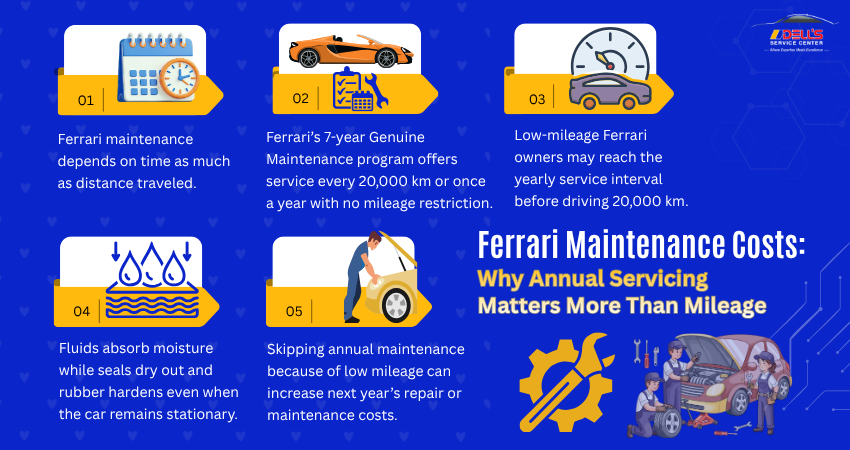
Time counts as much as distance. Ferrari’s 7-year Genuine Maintenance program offers two schedules: a service every 20,000 km, or once a year with no mileage restriction. A car that covers a few hundred summer miles reaches the yearly mark long before it gets anywhere near 20,000 km.
Why does time matter so much? Fluids absorb moisture, seals dry out and rubber hardens whether the car moves or not, and a car stored in an Ashwaubenon garage still sees humid summers and long winters. Storage doesn’t stop it. Skipping a year because the odometer barely moved only pushes that aging into next year’s invoice, usually with more on it.
Belt Service Is the Line Item That Moves the Number
Not every Ferrari has cam belts. Some engines drive their camshafts with toothed rubber belts and others use chains, and the maintenance booklet for your model and year says which you have and how often belt service falls due. Read that page first.
On a belt engine, Ferrari belt service is where the money goes. The belts are a small share of the bill, the hours spent reaching them are not, and a careful technician inspects the tensioners and bearings the belts ride on during the same visit. Rubber cracks and stretches with age and heat cycles even when the car hardly moves, which is why the time limit printed in the booklet counts every bit as much as the mileage figure beside it. Don’t stretch a belt interval because the car lives in a garage. Records and booklet disagree? Use the earlier date.
Clutch Wear and Fluids Fill In the Rest of the Bill
After belts, clutch wear is the big variable on older F1-gearbox Ferraris. That clutch is a real friction disc worked by a hydraulic actuator, and it wears fastest in stop-and-go traffic and tight parking lots. Measure it. The reading tells you whether the clutch goes into this winter’s plan or can wait another season.
Fluids are the steady part. An oil service here covers full synthetic oil, a new filter and a check of coolant, brake and transmission fluid levels. Those are small jobs. But brake fluid left well past its change date soaks up water, and corroded calipers are how a modest service year becomes an expensive one.
Winter Storage Is When the Big Service Fits Best
Book it at layup. Dell‘s own Ferrari page recommends storing the car through a harsh Wisconsin winter, and from late November to April a Ferrari on summer tires has little business on salted roads.
That leaves about five months. Belt or clutch parts can be ordered and fitted with nobody watching the calendar, and the car comes out in spring with its paperwork current. Put a battery maintainer on it while it sits. A Ferrari that goes flat over the winter can come out of storage with a string of electrical warnings to chase, and the charger costs far less than that hunt.
Outside the Factory Program, the Owner Picks the Shop
Ferrari offers its 7-year program on new cars and on pre-owned cars bought from an official dealer, carried out by technicians trained at Ferrari’s training center in Maranello. Once a car passes its seventh year, that program is over, and the owner sets the schedule and picks the shop.
Dell’s Service Center has worked on European and luxury cars in Green Bay since 1969, and it is owned by an ASE Certified Master Technician. Its Ferrari list covers engine and clutch repair, diagnostics, software updates, oil changes and pre-race track inspections, and most parts and repairs carry a 12-month/12,000-mile warranty. Keep every invoice. A complete service history protects resale value better than any single stamp in the booklet.
Frequently Asked Questions
Q: How much does Ferrari maintenance cost per year?
A: It depends on the model, its age and what falls due that year. The annual service with fluids is the baseline. Plan separately for the years that add belt service on a belt engine or a clutch on an F1-gearbox car, rather than averaging them out.
Q: How often does a Ferrari need a timing belt service?
A: Only belt-driven Ferrari engines need one, at the interval in the maintenance booklet for that model and year. The booklet gives a time limit and a mileage limit, and a low-mileage car usually hits the time limit first.
Q: When is the best time to service a Ferrari in Wisconsin?
A: At layup. Booking the service in late November gives parts weeks to arrive while the car sits, and it comes out in spring ready to drive rather than waiting on a lift.
Q: Does a Ferrari need servicing if it isn’t driven?
A: Yes. Ferrari’s own program includes a once-a-year schedule with no mileage restriction, because fluids, seals and belts age in storage too.
Plan the Ferrari’s Winter Service in Green Bay
Bring the car and its maintenance booklet to 840 Van Der Perren Way, Green Bay, WI 54304, so the last belt date and the clutch reading can be checked before it goes under the cover. A layup visit is the right time. Send the model, the year and the date of the last belt service ahead of time through the contact form on dellsservicecenter.com, and the winter plan can be sorted before the first snow.