

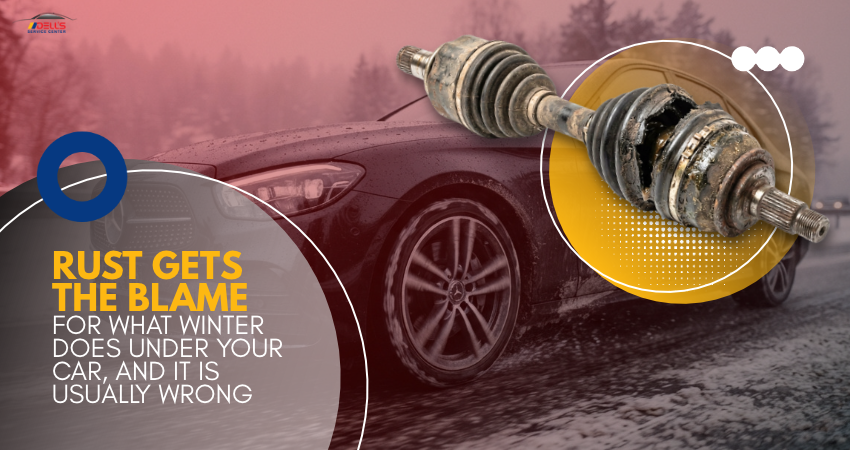
Owners assume the underside of a car in Wisconsin dies of corrosion, and some of it genuinely does. The drive axles do not, though — they die of grit, and the grit only gets in because a piece of rubber the size of a fist split open and nobody looked.
The boot does the work, the joint takes the blame
A constant velocity joint is a set of hardened steel balls riding in machined grooves, packed in heavy grease and sealed inside a pleated rubber boot. The joint itself is close to indestructible while that seal holds. It will outlast the car.
Once the boot splits, two things happen within a week of winter driving. Grease flings out through the tear and the joint starts running dry, and salt slurry packs in through the same tear and starts grinding the ball tracks. Neither of those is reversible once it starts.
What is actually on the road under you
Highway deicing accounted for about 41 percent of all salt consumed in the United States in 2024, the U.S. Geological Survey reported in its 2025 mineral commodity summaries. Wisconsin takes a serious share of that, and the brine does not stay on the pavement. It atomizes, coats everything within a foot of the road surface, and finds any opening it can.
Sand and gravel thrown up behind a plow does the mechanical half of the job, blasting the boot surface and the clamps that hold it. A clamp that corrodes through and lets go does exactly the same damage as a tear.
→ Suspension repair in Green Bay
The noise, and what it tells you about timing
A dry or contaminated outer joint clicks, and it clicks in a very specific way: on tight turns, at low speed, louder when the wheel is at full lock. Backing out of a parking space in a circle will produce it when driving straight will not.
By the time it clicks, the decision has already been made for you. Clicking means the ball tracks are worn and an axle is going in. The window where a boot replacement would have saved the joint closed weeks earlier, quietly, with nothing more than a faint spray of grease on the inside of the wheel.
The inner joint, and a different symptom
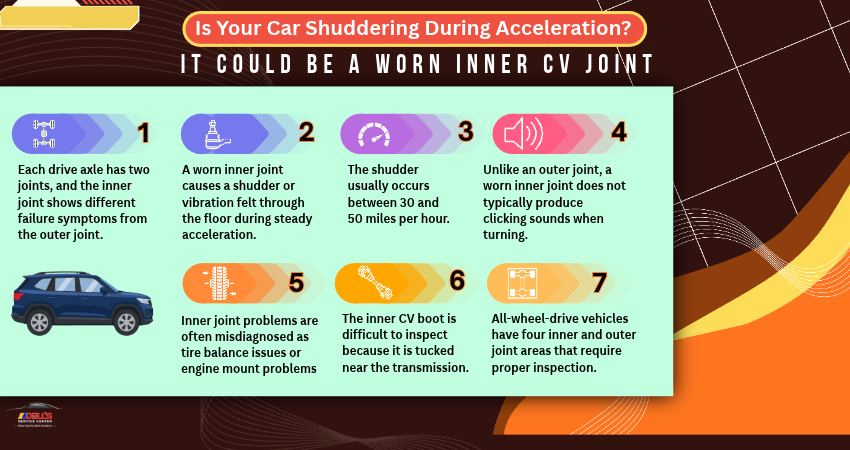
Each drive axle has two joints and the inner one fails differently. Instead of clicking on turns, a worn inner joint produces a shudder you feel through the floor under steady acceleration, usually between 30 and 50 miles an hour, and it gets misdiagnosed as a tire balance problem or an engine mount.
The inner boot is also harder to see, tucked up near the transmission where nobody shines a light. On an all-wheel-drive car there are four of these out of sight, which is a good argument for having someone who knows where to look do the looking.
Grease on the inside of a wheel
This is the whole early warning system, and it takes about four seconds per wheel. Turn the steering to full lock, look at the back face of the wheel and the inner fender liner, and look for dark streaks radiating outward.
Flung CV grease is distinctive. It is thick, tar-dark, and it lands in a fan pattern because it leaves a spinning part. Brake dust is fine and even; this is not that. Anyone can check it in a driveway with a flashlight.
Why December is when boots fail
Rubber hardens as it gets cold, and a boot that has spent four Wisconsin winters cycling between stiff and soft is already full of fine cracks in the pleats. The pleats flex every time the wheel turns, so the cracks open under load, and the first hard steering input on a frozen morning is often what finishes the job.
Boot replacement against axle replacement
If the boot is torn and the joint is quiet, a reboot and repack is the right call and it is the cheaper one. The joint gets cleaned out completely, inspected for pitting on the ball tracks, repacked with the correct grease and sealed with new clamps.
If the joint has any play, any roughness turning by hand, or it has been clicking, replace the axle. We will tell you which one you are looking at after the wheel comes off, and we would rather do the cheap job when the cheap job is honest.
→ Brake repair for cars that see road salt
A ten-minute look during a routine visit
The practical fix for all of this is to have someone look while the car is already up. An oil service puts the vehicle on a lift anyway, the wheels are right there, and a torn boot found in November is a different repair than the same tear found in March.
That is the whole argument. Catch the rubber and you keep the joint; miss the rubber and you buy an axle. One note on parts while we are here: remanufactured axles vary enormously in quality, and the cheap ones often arrive with a boot no better than the one that failed.
Book the Winter Undercar Look
Dell’s Service Center, 840 Vanderperren Way, Green Bay. Everything we service is listed at dellsservicecenter.com, and the quickest way to get on the schedule is below.