


The bags are packed, Door County is two hours up the road, and the last thing you want is to spend it waiting on a tow near Sturgeon Bay. A little prep fixes that. Summer heat, a loaded car, and long highway miles on 41 and 43 stack stress on the systems that strand people most.
This is the short list we run before a customer heads out. Nothing fancy. None of it is glamorous. All of it is cheaper than a breakdown three counties from home. Here’s what to check.
Quick Summary: Key Takeaways
- Cooling first: Heat plus a loaded car is what turns a marginal hose or water pump into a roadside stop.
- Brakes and tires carry the load: More weight and more miles mean both need to be right before you go.
- Fluids and battery matter: Summer heat is harder on a battery than winter, and old oil works harder when it’s hot.
- A/C is a real check: A long drive with kids and no cold air is a trip nobody enjoys.
- One diagnostic scan catches the rest: A pre-trip scan flags the small stuff before it becomes the big stuff.
Start With the Cooling System, Because Heat Is the Enemy
Cooling is where summer road trips go wrong, so we start there. Hoses get soft and swell, the coolant loses its corrosion protection over the years, and a water pump that’s been quietly weeping picks a hot afternoon on the interstate to finally quit. A quick pressure test tells us whether the system holds.
On European cars especially, this is worth doing before a long haul. Do it early. We check the coolant condition, the pressure cap, every hose, and the water pump, then top the system off with the exact coolant your European car’s engine was designed to run. Better to find a soft hose on the lift than on the shoulder. Way better.

Brakes and Tires Do More Work When the Car Is Loaded
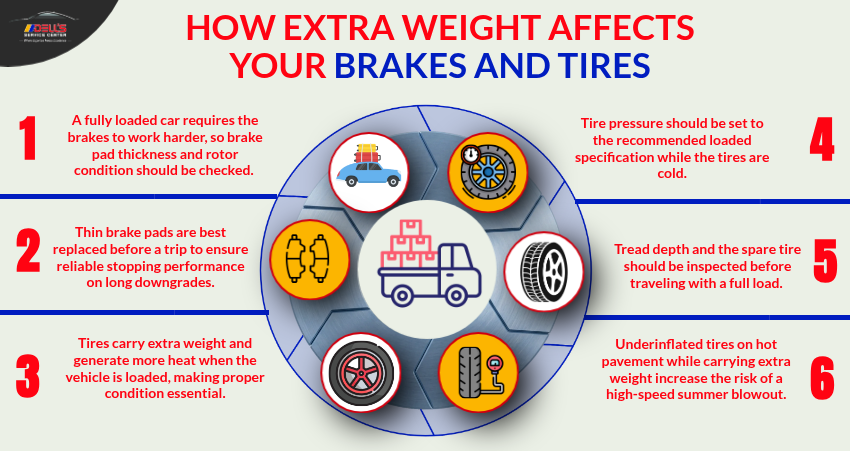
A car packed with people and gear stops harder and rides on hotter tires, so both systems get a real look. We measure pad thickness and check the rotors, because fading brakes on a long downgrade with a full load is exactly when you need them most. Thin pads before a trip are an easy fix now.
Then the tires. Set the pressures cold to the loaded spec, check the tread, and don’t forget the spare. Hot pavement and an underinflated tire, both carrying more weight than usual, are exactly how a summer blowout happens at 70 mph out on the interstate.
Fluids, Filters, and the Battery Round Out the Basics
The unglamorous stuff prevents most breakdowns. If your oil is anywhere near its interval, change it before you go, because hot highway miles under a full load are the hardest, most sustained work an engine does all year. We check the brake fluid, transmission fluid where applicable, and the cabin air filter so the AC actually pushes cold air instead of forcing it through a whole season of trapped pollen and road grime.
Then the battery. People blame winter, but AAA notes that summer heat kills more batteries than winter cold, so a battery that’s three or four years old is well worth a quick load test before you trust it to start the car 200 miles from home on a hot day.
Don’t Skip the Air Conditioning Check
AC is a comfort item until it’s July and you’re stuck in it, then it’s the whole trip. A system that blows cool at idle in the driveway can quietly fade on a long, hot highway pull near Manitowoc, right when a car full of restless kids needs it to work its hardest. We check the refrigerant charge and the compressor so you’re not sweating it near Manitowoc.
Cold air, happy passengers. It’s a five-minute check that saves a miserable drive.
A Pre-Trip Scan Catches What the Eye Misses
The fastest way to buy peace of mind is a diagnostic scan before you leave. We pull codes on the engine, transmission, and safety systems, so a stored fault that hasn’t lit the dash yet turns into a planned fix instead of a surprise on the road. On modern European cars, that scan finds things a visual check never will.
We’ve done this in Green Bay since 1969. Nationally, a record 72.2 million Americans traveled over the 2025 Fourth of July week, 61.6 million of them by car, so the roads are packed and help is slow – a little prep keeps you off that list.
Frequently Asked Questions
Q: What should I check on my car before a summer road trip?
A: Cooling system and coolant, brakes and tires, engine oil and other fluids, the battery, the AC, and a diagnostic scan for stored codes. The idea is to find the weak link in the driveway rather than on the highway. A shop can run the whole list in about an hour.
Q: How far ahead should I get my car inspected before a trip?
A: At least a week out. That leaves time to order any parts and handle a repair without wrecking your travel plans. A check the night before often means either driving on a known problem or canceling, so build in a cushion.
Q: Is summer heat really hard on a car battery?
A: Yes. Heat evaporates the fluid inside the battery and speeds internal wear, so summer actually kills more batteries than winter cold does. If yours is three years or older, have it load-tested before you rely on it far from home.
Q: Do I need a pre-trip inspection if my car feels fine?
A: It’s still worth it, especially on an older European car. Many failures – a weeping water pump, thin brake pads, a weak battery – give few symptoms until they strand you. A scan and a quick check turn those into planned repairs.
Get Road-Trip Ready Before You Head Out
Leaving town this summer? Bring it in for a pre-trip check and drive off knowing the car is ready.
Dell’s Service Center – 840 Van Der Perren Way, Green Bay, WI 54304
Hours: Monday-Friday, 7:30 AM – 5:30 PM
Website: dellsservicecenter.com