



Quick Takeaways:
- A flashing check engine light on a Mercedes indicates an active engine misfire — a more serious condition than a steady CEL.
- Active misfires can destroy catalytic converters within minutes of sustained driving — repair cost escalates dramatically.
- Common causes of Mercedes misfires include ignition coil failure, spark plug wear, fuel injector issues, and boost leaks on turbocharged models.
- Green Bay winters are especially hard on ignition coils — the thermal stress of cold starts on sub-zero Brown County mornings accelerates internal coil breakdown.
- Dell’s Service Center at 840 VanDerPerren Way has Mercedes diagnostic capability to identify the misfire cause and prevent further damage.
Green Bay drivers covering I-43 south toward De Pere, cutting through Allouez on their way to the west side, or sitting in the Lambeau Field game-day traffic on Oneida Street know that a check engine light at the wrong moment is a problem. A flashing check engine light is a different category entirely. Mercedes drivers commuting from Howard or Ashwaubenon who notice their CEL blinking during a cold-start run down Military Avenue are experiencing the engine management system’s emergency communication: an active misfire is occurring, unburned fuel is passing through the exhaust, and the catalytic converter is being subjected to temperatures it was not designed to handle. Dell’s Service Center has been at 840 VanDerPerren Way since 1969 — started by Dell Lubenske Sr. as an Enco station on Ashland Avenue — and handles Mercedes misfires with the XENTRY diagnostic software the job requires.
What is the difference between a flashing and a solid Mercedes check engine light?
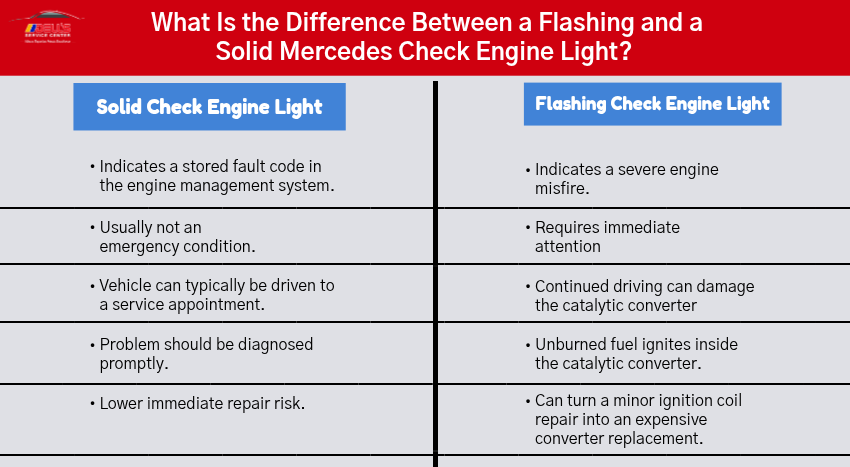
A solid check engine light means the engine management system has detected and stored a fault code — something worth diagnosing promptly, but not an emergency. You can typically drive the vehicle to a service appointment on Webster Avenue or VanDerPerren Way without immediate risk.
A flashing check engine light signals a misfire severe enough that unburned fuel is passing through the exhaust and igniting inside the catalytic converter. The converter’s internal honeycomb substrate can melt within minutes of sustained misfiring. Continued driving — whether on I-43 through Green Bay or on a short run down Lombardi Avenue — risks destroying the converter and turning a $300 ignition coil replacement into a $2,000 converter replacement. If your Mercedes CEL is flashing in Green Bay, contact Dell’s Service Center at (920) 494-2860 ASAP.
What causes a Mercedes engine to misfire in Green Bay?
Ignition coil failure is the most common cause. Each cylinder has its own coil, and when one fails, that cylinder passes unburned fuel directly to the exhaust. Green Bay winters are particularly hard on ignition coils — the thermal stress of cold starts on sub-zero Brown County mornings followed by rapid heating creates the repeated expansion and contraction cycle that breaks down coil winding insulation fastest.
Spark plug wear amplifies coil failure risk. Fuel delivery issues — weak injectors or low fuel pressure — cause lean misfires. Boost leaks on turbocharged Mercedes engines create lean conditions under load that misfire at highway speed on I-43. The Green Bay freeze-thaw season from October through March is especially demanding on all of these components. Schedule a Mercedes misfire diagnosis at Dell’s Service Center in Green Bay.
What damage can a sustained misfire cause to a Mercedes?
The catalytic converter is the most immediate victim. The converter’s ceramic honeycomb substrate, coated with platinum and palladium catalysts, melts when subjected to raw fuel combustion. A converter subjected to sustained misfiring may melt internally and create a blockage that then causes additional performance problems even after the misfire is repaired.
Misfires also stress the engine mechanically. Repeated incomplete combustion events cause carbon buildup on the affected cylinder’s piston and valves, and the combustion imbalance places asymmetric load on the crankshaft and bearings.
What should I do if my Mercedes check engine light is flashing in Green Bay?
Pull over safely and turn the engine off as soon as possible. Do not continue driving — not to finish an errand in the Titletown District, not to reach the next exit on I-43. Contact Dell’s Service Center to arrange transport. Book your Mercedes check engine light diagnosis at Dell’s Service Center in Green Bay to get a definitive answer and protect your engine and catalytic converter.
Once at the shop, a technician will read the fault codes to identify which cylinder is misfiring and systematically test the ignition system, fuel injectors, and compression to pinpoint the root cause before any parts are replaced.
Frequently Asked Questions
Q: Can I drive my Mercedes to Dell’s Service Center if the check engine light is flashing?
A: If the light is flashing, the answer is generally no for any significant distance. Contact Dell’s Service Center at (920) 494-2860 to explain the situation — they can advise on whether a brief drive to VanDerPerren Way is reasonable or whether towing is the right call based on your specific symptoms and distance.
Q: How much does Mercedes misfire repair typically cost at Dell’s Service Center?
A: Ignition coil replacement for a single-coil misfire is one of the more affordable repairs. If the catalytic converter has sustained damage, the total cost increases significantly. Dell’s provides a complete assessment before any repair is authorized so you know the full scope upfront.
Q: My Mercedes check engine light stopped flashing and is now solid. Is the problem resolved?
A: Not necessarily. The flash threshold dropped below the emergency level, but the underlying cause is likely still present. Schedule service promptly even if the light has settled — the stored misfire codes help Dell’s Service Center focus the diagnosis.
Q: Does Dell’s Service Center service Mercedes-Benz models under warranty?
A: Dell’s Service Center is an independent European repair facility rather than an authorized dealer. Independent shops can perform all maintenance and repairs without voiding factory warranties under the Magnuson-Moss Warranty Act. Contact the shop to discuss your warranty situation.