



In an Audi, an engine misfire occurs when cylinders fail to ignite the air-fuel mixture at the correct time. Three elements –spark, fuel, and air― are needed to be present in correct measures for combustion to happen successfully, and if one or more of them are absent, then the combustion fails and the engine misfires.
Common Causes Behind an Audi Engine Misfire
- Ignition System issues: Faulty Spark Plugs, defective ignition coils, or worn spark plugs cause ignition system malfunction that fails to produce a proper spark at the right time.
- Fuel System Problems: Malfunctions such as clogged or failing fuel injectors, low fuel pressure due to a damaged pump, carbon deposits on intake valves, and dirty fuel can result in irregular fuel flow and improper ignition.
- Air and Compression Issues: Vacuum leaks, Mass Airflow (MAF) sensor failure, Oxygen (O2) sensor failure, and low engine compression can cause an irregular air-fuel mixture ratio, affecting combustion, and leading to misfires. In addition to these, an Engine Control Unit (ECU) malfunction disrupts engine function and causes misfires.
Signs of an Audi Engine Misfire
Recognizing the symptoms of engine misfire can save you from hefty repairs and extensive engine damage. According to our expert technicians at Dell’s Service Center in Green Bay, the common signs of engine misfires are;
- Rough Idle or Engine Vibration
- Loss of Power and Acceleration
- Check Engine Light ignition
- Reduced Fuel Economy
- Unusual Exhaust Smell of raw fuel
- Difficulty Starting or Stalling:
- Engine Knocking or Pinging
- Increased Emissions
Diagnosing an Audi Engine Misfire
As engine misfire could stem from multiple system failures, the diagnostic scope expands to various modules or system inspection. However, the initial step comprises the diagnostic scan that isolates or identifies the malfunction. Audi-specific diagnostic scanners, such as VCDS, are connected to the vehicle, and the scan is initiated. This retrieves the fault codes and their freeze-frame data stored in the ECU, then analyzes them to pinpoint the malfunction. If further inspection is needed, then live data monitoring of fuel trims, O2 sensor readings, MAF readings, and misfire count is done.
After the diagnostic scan, individual component tests are conducted on top of the scan results. These tests could be one ignition, fuel delivery, or air compression module. Ignition system inspection involves visual inspection of ignition coils and spark plugs, a swap test of ignition coils, and spark testing. The fuel system investigation includes a sound test of the fuel injector, a fuel pressure test, and an analysis of the fuel trim data. Similarly, the compression inspection involves a vacuum leak test, a visual and smoke machine inspection, a crab cleaner test, an MAF sensor test, and a compression test.
5 Ways to Fix an Audi Engine Misfire
1. Spark Plugs Replacement
Damaged spark plugs are replaced with OEM-made, high-quality replacements. It’s generally recommended to replace all spark plugs as a set, even if only one is causing a misfire.
2. Ignition Coil Replacement
High quality, Audi compatible. OEM-made ignition coils are installed after removing the old and damaged ignition coils. It is recommended to replace all coils as a set, especially if they are original and of similar age/mileage.
3. Clogged Fuel Injector Repair
Minor clogging of fuel injectors is treated by thorough cleaning with high-quality fuel system cleaner. If the cleaning fails and the clogging has damaged the injector, then fuel injector replacement is the only way.
4. Fuel Pump Repair and Replacement
If the issue stems from the fuel pump, it is repaired or replaced depending on the extent of damage. Fuel pump damage could be on the low-pressure in-tank pump or the high-pressure fuel pump.
5. Repair for Compression-Related Issues
Fixing vacuum leaks, cleaning or replacing the MAF sensor, cleaning or replacing the oxygen sensors, and walnut blasting to remove carbon buildup are the repairs for compression issues. If the diagnosis points to low compression, then it requires major engine repair, such as replacing piston rings, valves, or the head gasket. After repairs, the fault codes are erased and the control unit is reset to ensure optimal, seamless engine operation.
Why Choose Dell’s Service Center in Green Bay?
To address engine misfires in your Audi, 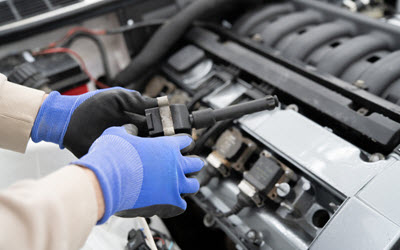 Dell’s Service Center has expert, ASE-certified master technicians with years of experience with Audi and other European-brand auto issues. We are the premier European auto service facility in Green Bay, equipped with state-of-the-art repair tools and factory-grade diagnostic equipment to ensure accurate, reliable repairs for your Audi. We ensure and improve the quality of our repairs by using OEM parts and components, and brand-approved fluids in your vehicles. We provide a 12-month/12,000-mile warranty on most of our repairs and services. Located at 840 Vanderperren Way, we welcome residents of Green Bay and surrounding cities, including Manitowoc and Sturgeon Bay.